Amarillo Lot Striping: parking lot striping in Amarillo, Texas
Amarillo Lot Striping paints parking lots across Amarillo and the surrounding Texas Panhandle, from single-tenant strip centres on Soncy Road to campus overflow lots and industrial yards off Loop 335. Striping is the visible half of the job. The half that decides whether the lot still reads clearly in three summers is surface preparation, paint selection and a layout measured on the ground.
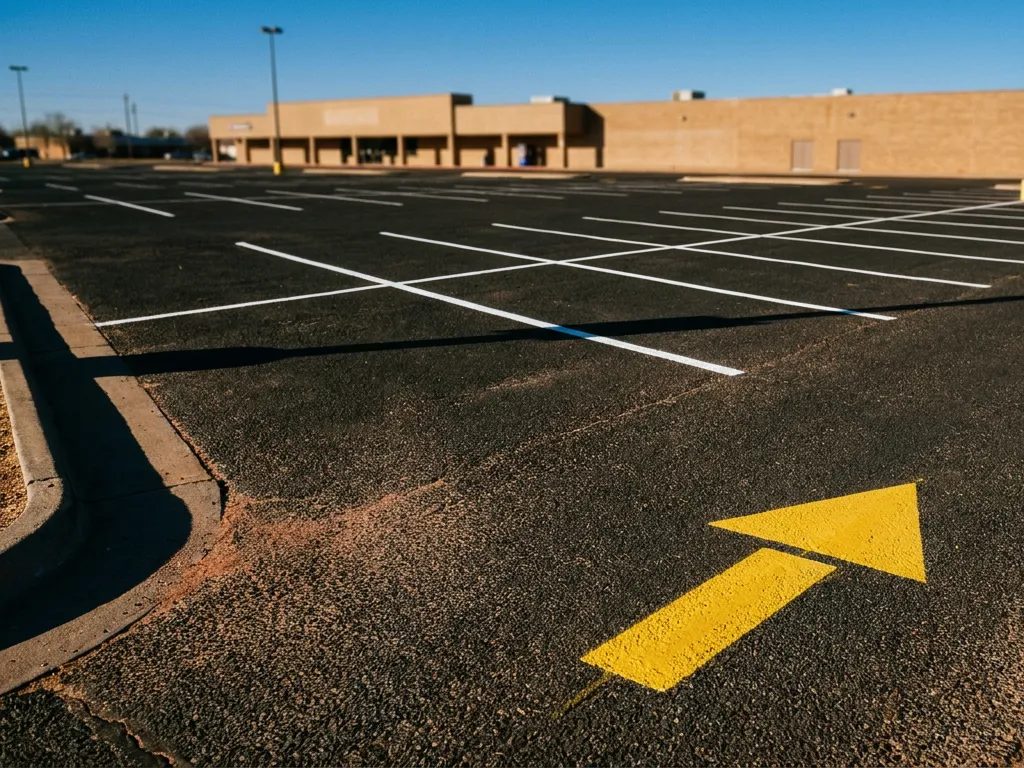
What a striping job actually consists of
Paint is the last two hours of the work. Most of a striping day is spent on the surface underneath it, because traffic paint bonds to what it touches and nothing else. A lot that has been swept but not scrubbed will hold paint through one winter and start shedding in the second.
On a typical restripe we walk the lot first, mark the layout from the existing bond lines, blow and sweep the paint path, and cut in stalls with a walk-behind airless striper. On new asphalt we wait out the cure before anything is applied, which on a Amarillo summer pour can be shorter than the thirty days people expect and on a November pour can be considerably longer.
The sequence on a standard commercial lot:
- Walk the lot and measure the existing layout, noting stall widths, aisle widths and anything that will not meet current accessible-route requirements if it is simply repainted as found.
- Agree the layout on paper before a single line is painted, including any change to stall count.
- Blow the paint path clear of sand and grit, then scrub or pressure-clean any area carrying oil, tyre rubber or sealer bloom.
- Lay out with chalk or a string line, checking diagonals on any stall bank longer than ten spaces.
- Spray at the specified wet mil thickness, cutting stalls first, then arrows, symbols and legends.
- Barricade and hold the lot until the paint has cured past the point where tyres will lift it.
Paint, and why the choice matters more here than it does further east
Most commercial lots in Amarillo are painted with a waterborne acrylic traffic paint meeting the general requirements of Federal Specification TT-P-1952. It is the right default: fast return to service, low odour, and it takes glass bead reflectorisation when a lot needs it.
The variable that catches people out is film thickness. Paint is sold by the gallon but performs by the mil. A line laid at 10 wet mils and the same line laid at 15 wet mils are different products in terms of service life, and the difference is invisible on the day the lot reopens. We specify the wet mil thickness in writing, and on request we will check it with a wet film gauge while the work is in progress.
| Paint type | Waterborne acrylic traffic paint | General requirements of Fed Spec TT-P-1952 |
|---|---|---|
| Wet film thickness | 15 mils | Specified in writing; 10 to 12 mils is common and shorter-lived |
| Standard stall line | 4 inches wide | Single line between stalls unless the layout is double-lined |
| Fire lane and curb | Traffic yellow or red per the fire code requirement for that lot | |
| Dry to touch | 30 to 60 minutes | Faster in Amarillo summer, considerably slower on a damp autumn morning |
| Return to traffic | 2 to 4 hours | Longer if humidity is high or the surface temperature is below 50F |
| Glass beads | On request | Worth it on unlit lots and on directional markings near an exit |
Layout: the part that is worth arguing about
A parking lot is a compromise between stall count and usability, and the compromise is settled by the module: the depth of two facing stalls plus the drive aisle between them. Change the stall angle and the module changes, which is why a lot laid out at sixty degrees can carry more cars than the same lot at ninety, or fewer, depending entirely on how the drive aisles resolve at the ends.
We measure the module before proposing any change to a layout, because the most expensive striping mistake is a lot that gains six stalls and loses the ability to take a delivery truck through it. On retail lots with a rear service drive this is the question we ask first.
| 90 degree stall | 9 ft by 18 ft | Drive aisle 24 ft, two-way traffic |
|---|---|---|
| 60 degree stall | 9 ft wide, 20 ft 9 in deep | Drive aisle 18 ft, one-way traffic |
| 45 degree stall | 9 ft wide, 19 ft 1 in deep | Drive aisle 13 ft, one-way traffic |
| Compact stall | 8 ft by 16 ft | Only where the local ordinance permits a compact ratio |
| Accessible car stall | 96 in plus 60 in access aisle | ADA 2010 Standards section 502 |
| Van accessible stall | 132 in, or 96 in plus a 96 in aisle | At least one van space per six accessible spaces |
Repainting a non-compliant layout does not preserve it
A lot striped before the 2010 ADA Standards took effect may have accessible stalls that no longer meet current dimensions. Repainting those stalls exactly as found is a decision with consequences, and it is the property owner who carries them, not the striping contractor.
We measure the accessible stalls on every restripe and tell you in writing what we found before we paint. What you do with that is your call, and for anything that needs a registered review we will say so rather than guess.
Why Amarillo lots fade the way they do
Amarillo sits a little over 3,600 feet above sea level on the Llano Estacado, and the ultraviolet load at that elevation breaks down the binder in traffic paint faster than it does at the same latitude nearer the coast. Yellow pigment gives up before white does, which is why fire lanes and accessible markings are usually the first thing on a lot to need attention.
Add blowing sand, which thins the film at the leading edge of each stripe, and a surface that runs above 140F in July and below freezing in January. The practical consequence is not that you need an exotic coating. It is that film thickness and surface preparation decide the outcome here more than they would in a milder climate, and that a realistic service life is shorter than a brochure written elsewhere will tell you.
Questions we get asked
How much does parking lot striping cost in Amarillo?
Pricing follows the count, not the square footage: stalls, arrows, symbols, accessible spaces, curb footage and any layout change. A straightforward restripe is the cheapest work we do, because the existing bond lines are the layout drawing. A relayout costs more because everything is measured and set out from scratch.
How long before we can park on it?
Two to four hours in typical Amarillo conditions, and often closer to two in summer. Cool, damp or still air slows it down. We stage the work so that a lot can usually stay partly open, painting half at a time, but the freshly painted half has to stay barricaded until it is genuinely cured. Driving on paint that is dry to the touch but not cured is what produces the tyre tracking you see on lots that reopened too early.
Should the lines be white or yellow?
For ordinary stall lines on a private commercial lot, white is the common default and reads better at night. Yellow is conventionally used for separation where traffic moves in opposing directions, for loading zones, for curbs where parking is restricted, and for fire lanes where the local fire code calls for it. The one rule that matters more than convention: whatever is already painted for a regulated purpose on your lot should be replaced in the same colour unless there is a documented reason to change it.
How often does a commercial lot need restriping?
On the Texas Panhandle, an ordinary retail lot painted at a proper film thickness reads well for two to three years before the lines start to look tired, and high-traffic drive aisles go first. Lots that see heavy truck turning, or that carry blown sand most of the year, come round sooner. The honest test is not the calendar: go out at night in the rain and see whether the stall lines still read. If they do not, the lot is due.
Do you stripe new asphalt?
Yes, once it has cured. Fresh asphalt releases oils that stop paint bonding, and painting too early produces lines that look fine for a month and then peel in sheets. The wait is commonly quoted as thirty days, but it genuinely depends on the mix, the thickness and the weather since the pour. We check rather than assume, and on a hot-weather pour it is often shorter than people expect.
Next step
Get a written price for your lot
We walk the lot, count what has to be painted, measure the accessible stalls and give you an itemised schedule. No charge for the visit.
MON-FRI 7A-6P · NIGHT AND WEEKEND WORK BY ARRANGEMENT