Amarillo Lot Striping: warehouse floor striping in Amarillo, Texas
Amarillo Lot Striping marks warehouse and plant floors across Amarillo and the surrounding Texas Panhandle industrial properties, from distribution space along the Interstate 40 corridor to the older masonry warehouses near the BNSF yard. Floor marking inside a building is a different job from parking lot striping: different surface, different paint, and a layout driven by forklift traffic rather than car parking.
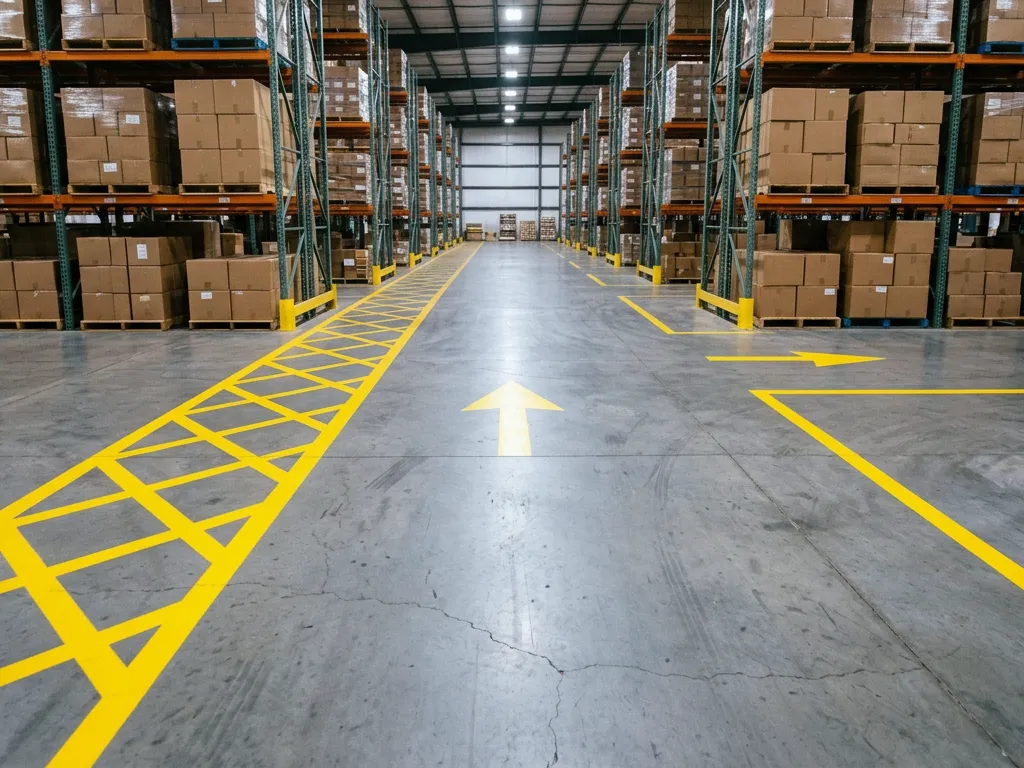
Concrete is not asphalt
A sealed, power-trowelled concrete floor is a much harder and much less porous surface than asphalt, and paint that performs well outdoors on a parking lot can sit on top of it rather than bonding into it. Floor marking generally calls for a coating chosen for concrete, and on a floor that has been sealed or has a densifier applied it often calls for mechanical preparation first.
The other difference is what runs over it. A forklift with solid tyres, turning under load in the same spot a hundred times a day, is a far harsher wear pattern than a car crossing a stall line. Aisle intersections and the pivot points in front of racking are where floor marking fails first, and they are where preparation matters most.
| Forklift aisle line | 2 to 4 in | Wider on main runs, narrower on secondary aisles |
|---|---|---|
| Pedestrian walkway | 2 to 3 ft wide | Bordered both sides, frequently hatched or infilled |
| Equipment footprint | Outline to the machine | Marks where a machine belongs and where it must not encroach |
| Staging and hold areas | Hatched or corner-marked | Corner marks wear far better than full outlines |
| Rack and bay identification | 4 to 12 in characters | Sized to be read from the seat of a lift truck |
| Hazard and keep-clear | Diagonal hatching | Electrical panels, eyewash, fire equipment, exits |
Laying out a floor that people will actually follow
The quickest way to get floor marking ignored is to draw the aisles where the drawing says they should be rather than where the traffic already goes. On an operating floor there are established desire lines, and a marked aisle that cuts across one will be crossed rather than followed.
We walk the floor during a working shift before proposing a layout, because the difference between the intended flow and the actual flow is the whole design problem. Where the two genuinely conflict, the right answer is usually to move the racking or the staging rather than to paint an aisle nobody will use.
What we mark on a typical distribution floor:
- Main and secondary forklift aisles, with intersections treated for wear
- Pedestrian walkways separated from lift truck routes, with marked crossing points
- Dock approach and staging lanes tied to the door numbering
- Keep-clear zones at electrical panels, eyewash stations, fire extinguishers and exit routes
- Equipment footprints, pallet drop zones and returns areas
- Rack, bay and door identification numbering at a size readable from a lift truck
Working around an operating shift
Almost every floor we mark is in use, and the constraint is rarely the painting. It is the cure window, and the fact that a forklift crossing a line before it has hardened will take the line with it and print it across the rest of the floor.
On a single-shift operation we can usually work between shifts and hand the floor back in the morning. On continuous operations the work gets sectioned, and we would rather mark a quarter of the floor at a time over four visits than rush a cure and have to come back anyway. We agree the sectioning and the handover times before we arrive.
Marking is not a substitute for a traffic plan
Paint on a floor communicates a plan. It does not create one, and it does not by itself satisfy any obligation a business has for pedestrian and vehicle separation.
We mark to the layout your operation decides on. Where a layout looks to us like it puts foot traffic and lift trucks in the same place, we will point at it before painting, but the plan is yours and so is the decision.
Questions we get asked
What colour should forklift aisles be?
Yellow is the common convention for aisle and traffic marking, with white frequently used for equipment footprints and storage areas, and hatched or contrasting treatments for keep-clear zones. Many operations also carry a site colour standard already, sometimes inherited from a parent company. Where one exists we mark to it rather than to the general convention, because internal consistency matters more than matching somebody else.
Do you have to grind the floor first?
On a sealed or densified concrete floor, usually yes, at least where the marking will take turning traffic. Paint applied over a sealer is sitting on a release layer, and it will peel at exactly the aisle intersections you most need it to survive. On an unsealed, clean floor a thorough scrub is often enough. We check the floor before quoting rather than assuming either way.
How long does the floor have to be out of use?
Long enough for the coating to harden rather than just dry, and that is the number that matters, because a lift truck on a line that is merely dry will lift it. Depending on the product and the floor temperature, that is typically overnight. We section the work so the whole floor is never down at once, and we agree the handover times with the shift supervisor before we start.
Can you mark an epoxy-coated floor?
Yes, and the preparation is different again. An epoxy floor is a coating rather than bare concrete, and the marking has to bond to that coating without softening it. That usually means a compatible product and an abrasion step rather than a grind. Tell us what is on the floor, and if nobody knows, we will test a small area out of the way before committing.
Do you do the dock numbering as well?
Yes, and it is worth doing at the same time as the staging lanes so that the numbers on the floor, the numbers on the doors and the numbers in the warehouse system agree. Mismatched dock numbering is a surprisingly common source of loading errors, and it is cheap to fix while the equipment is already on site.
Next step
Get a written price for your lot
We walk the lot, count what has to be painted, measure the accessible stalls and give you an itemised schedule. No charge for the visit.
MON-FRI 7A-6P · NIGHT AND WEEKEND WORK BY ARRANGEMENT