Amarillo Lot Striping: parking lot sealcoating in Amarillo, Texas
Amarillo Lot Striping seals and restripes asphalt parking lots across Amarillo and the Texas Panhandle, and we treat the two as one job because sealing a lot erases every line on it. The restripe afterwards is only straightforward if somebody measured the layout first, which is the step that gets skipped most often.
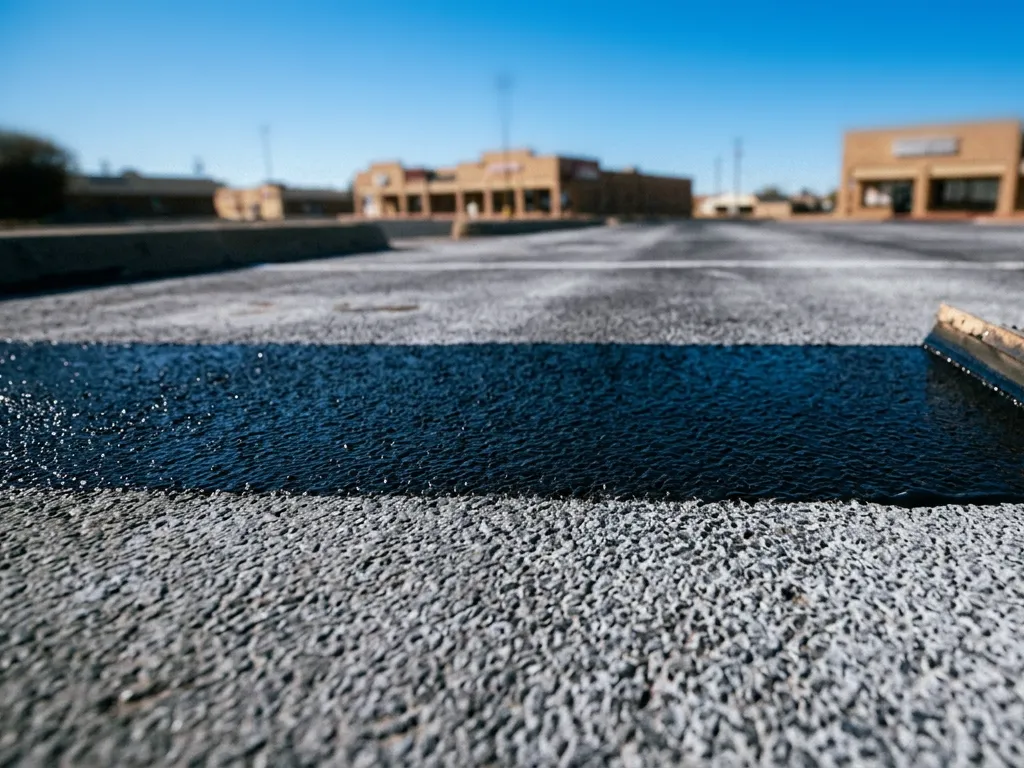
What sealer does, and what it does not
Sealcoat is a surface treatment. It replaces the fine surface binder that ultraviolet light and oxidation have taken out of the top of the asphalt, restores the black colour, and gives a uniform surface for paint to bond to. On a lot that is structurally sound but greying, it is genuinely good value.
It is not a repair. Sealer will not bridge a crack, will not hold together an alligatored area, and will not stop water reaching the base through a failure it has spanned. Applied over a lot with real distress, it produces something that photographs beautifully and fails in exactly the same places it was already failing, usually within a year.
The sequence we work to:
- Record the existing layout: stall widths, aisle widths, accessible stall dimensions, total count.
- Repair first. Crack fill and patch what needs it, and allow those repairs to cure before sealing over them.
- Clean thoroughly. Blow and sweep, then scrub oil spots and treat them with a primer, because sealer will not bond to oil.
- Cut in edges by hand around kerbs, buildings and drainage, then apply the body of the lot.
- Allow a full cure. Not dry to the touch, cured.
- Restripe to the recorded layout, or to the corrected layout if we agreed changes.
Curing on the Texas Panhandle
Sealer cures by water leaving it, which makes Amarillo a good place to do this work and an easy place to misjudge it. Low humidity and strong sun mean the surface can skin over quickly while the material underneath is still soft, and a lot opened on the strength of a dry-looking surface will show tyre scuffing and pull-up at every turning point.
Wind is the other factor. Amarillo is genuinely windy, and wind accelerates surface drying further while making overspray control around parked cars and buildings a real operational problem rather than a theoretical one. We plan the sequencing around both.
| Surface temperature | Above 50F and rising | |
|---|---|---|
| Air temperature | Above 50F for at least 8 hours after application | |
| Rain | None forecast for 24 hours | Rain on uncured sealer washes it into the drainage |
| Foot traffic | Commonly next day | |
| Vehicle traffic | Commonly 24 to 48 hours | Longer in cool or humid conditions |
| Striping after sealing | Once fully cured | Painting onto green sealer is a bond failure waiting to happen |
| Practical season | Spring through autumn on the Texas Panhandle |
Do not let anyone stripe green sealer
Paint applied onto sealer that has not fully cured sits on a soft surface and shears off it. It is the single most common cause of a lot whose brand new lines start flaking within months.
If the schedule is tight, the right thing to give up is the striping date, not the cure. We would rather come back than hand you lines that will not last the year.
The honest case against sealing
There are lots we will tell you not to seal. A surface with widespread alligator cracking has a base problem, and sealer over it is money spent on appearance. A lot scheduled for an overlay within a year or two does not need it. A lot where the drainage puts standing water across a third of the surface will fail the sealer in those areas first regardless of how well it goes down.
There is also a frequency argument. Sealer applied too often builds film thickness, and thick accumulated sealer becomes brittle and cracks on its own, independently of the asphalt underneath. More is not better.
Questions we get asked
How often should a parking lot be sealcoated?
Every few years is the usual guidance, and the right interval depends on traffic, sun exposure and the condition of the asphalt rather than a fixed calendar. What matters more is not overdoing it: sealer applied too frequently builds up, goes brittle and cracks on its own. If your lot still looks black and the surface is closed, it does not need sealing yet.
Do we have to restripe after sealcoating?
Yes. Sealer covers every line on the lot. That is why we record the layout before sealing, so the restripe is a matter of setting out a known layout rather than inventing one. If a lot gets sealed by somebody who did not measure first, the restripe afterwards costs more and the stall count sometimes comes back different.
How long before we can drive on it?
Commonly 24 to 48 hours for vehicle traffic and often next day for foot traffic, and both stretch in cool or humid conditions. The trap on the Texas Panhandle is a surface that skins over fast in the sun while the material underneath is still soft. We hold the lot on the cure rather than on the appearance, and we will say so if that pushes the reopening.
Can you seal around cars if the lot has to stay open?
We section the work instead. Sealing right up to parked vehicles is how cars get overspray, particularly in Amarillo wind, and a lot sealed in patches around obstacles has visible joins. Half the lot at a time, properly barricaded, gives a better result and is usually no slower overall.
Will sealcoating fix our cracks?
No. Sealer is a surface treatment and will not bridge a crack or hold together a failing area. Cracks get filled and failures get patched before sealing, as separate work, and those repairs need to cure before the sealer goes over them. Anyone offering to seal a cracked lot without repairing it first is selling you appearance.
Next step
Get a written price for your lot
We walk the lot, count what has to be painted, measure the accessible stalls and give you an itemised schedule. No charge for the visit.
MON-FRI 7A-6P · NIGHT AND WEEKEND WORK BY ARRANGEMENT