Amarillo Lot Striping: thermoplastic pavement marking in Amarillo, Texas
Amarillo Lot Striping applies thermoplastic markings on Amarillo properties where paint keeps wearing out faster than the budget cycle: entrance aprons, crosswalks, stop bars and the drive-aisle arrows on lots that move real volume. It lasts far longer than paint, it costs considerably more, and on most of the lots we look at it is the wrong product for most of the lot.
What thermoplastic is
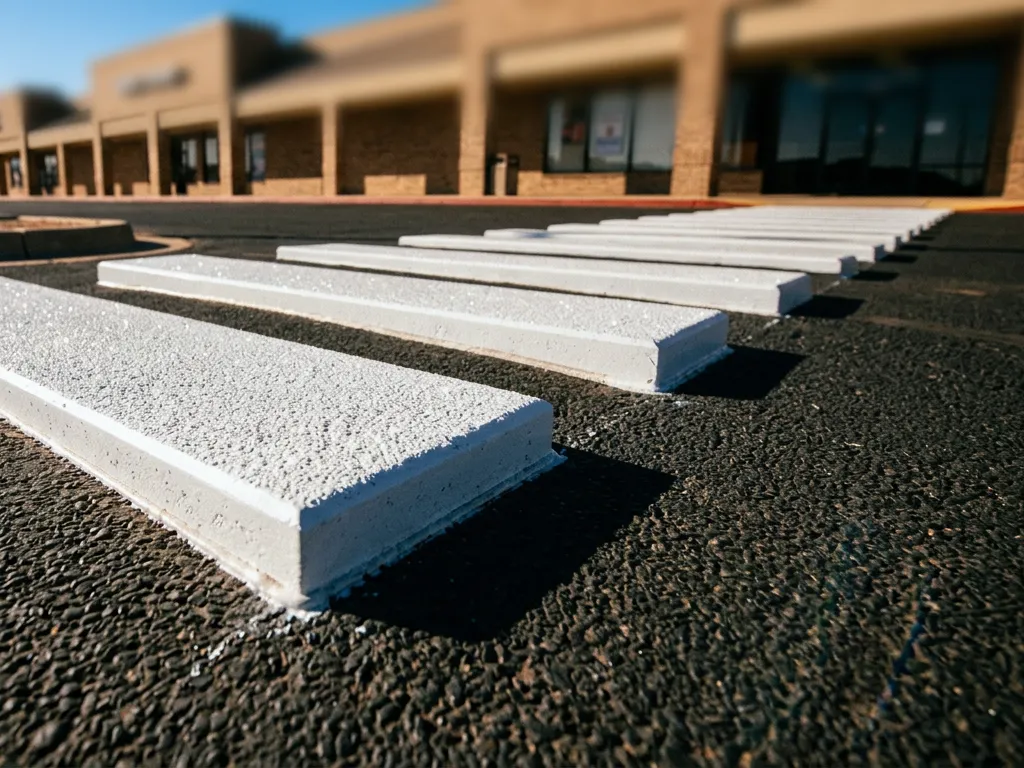
Thermoplastic is a solid material, supplied in blocks or granules, that is heated until it flows and then applied to the pavement where it cools into a hard, thick marking bonded to the surface. Where a painted line is measured in mils, a thermoplastic line is measured in tens of mils, and the glass beads are embedded through the material rather than dusted onto the top.
The result is a marking that survives traffic that would erase paint in a season, and that keeps its retroreflectivity much longer because beads are exposed continuously as the surface wears rather than only at the start.
| Applied thickness | 90 to 125 mils | Against 15 mils wet for traffic paint |
|---|---|---|
| Service life, high traffic | Several times that of paint | Depends entirely on turning traffic and surface condition |
| Relative cost | Substantially higher per foot | Both material and equipment |
| Surface temperature needed | Above 50F and rising | Limits the Amarillo season at both ends |
| Works on new asphalt | After cure, same as paint | |
| Works on concrete | With a primer or sealer | Bond on concrete is the usual failure point |
| Removal | Grinding | Harder to remove than paint. Get the layout right first |
Where it earns its cost on a Amarillo lot
Thermoplastic pays for itself where traffic crosses the marking rather than runs along it, and where the marking has a job to do beyond looking tidy. The entrance apron off a busy corridor like Soncy Road or Coulter Street takes every vehicle on the property across the same two feet of pavement. So does a crosswalk between a store entrance and the first row of parking.
It also earns its place where repainting is disruptive. Closing a hospital or clinic entrance to repaint a crosswalk every other year has a cost that does not appear on the striping invoice, and that is frequently the argument that decides it.
Worth specifying thermoplastic for:
- Entrance and exit aprons where the whole site crosses the same marking
- Crosswalks between a building entrance and the parking rows
- Stop bars at exits onto a public road
- Directional arrows in heavily used drive aisles
- Markings on a lot where closure for repainting is genuinely expensive
Where paint is the better buy
Ordinary stall lines are the clearest case. Cars park between them rather than driving over them, so they wear slowly, and there are thousands of feet of them. Specifying thermoplastic for stall lines multiplies the cost of the job without addressing anything that was actually failing.
The second case is any layout that might change. Thermoplastic is genuinely difficult to remove, and a lot that gets re-tenanted, re-striped for a different use, or resurfaced within a few years will pay twice: once to install and once to grind off. On a property that is on the market, or one where the anchor tenant is up for renewal, paint keeps your options open.
The third is cold weather. Thermoplastic wants a surface above 50F and rising, which on the Texas Panhandle narrows the working window at both ends of the year in a way paint does not.
We will tell you when not to buy it
Thermoplastic is the higher-margin product on this page and it is also the wrong answer for most of the square footage on most of the lots we look at.
The recommendation you will get from us is usually a hybrid: thermoplastic on the handful of markings that take crossing traffic, paint on everything else. That is cheaper than the all-thermoplastic quote and it lasts longer than the all-paint one.
Questions we get asked
Is thermoplastic worth it for a parking lot?
For part of one, often yes. For all of one, almost never. The markings that take crossing traffic, entrances, crosswalks, stop bars and aisle arrows, wear out fastest and are the ones worth the extra cost. Stall lines are driven over rarely and there are a great many of them, so paint is the better value there. We usually quote the hybrid.
How long does thermoplastic last?
Considerably longer than paint, and the honest answer is that the range is wide because it depends on the traffic crossing it, the condition of the surface underneath and whether the bond was good on the day. What we will not do is quote you a specific number of years as though it were a guarantee, because the variable that decides it is your traffic and not our material.
Can thermoplastic go over existing paint?
Not reliably. It bonds to the pavement, and a layer of old paint between the two is a weak link that shows up as sections lifting cleanly away. Where we are putting thermoplastic onto a marking that is currently painted, the paint comes off first, which is grinding work and is priced as part of the job.
Can it be removed if we change the layout?
Yes, by grinding, and it is harder work than removing paint. That is a real consideration on any property where the layout might change within a few years. If the lot is likely to be resurfaced, re-tenanted or re-planned, paint keeps that option cheap.
Can you install it in winter?
Only in the right conditions. The surface needs to be above 50F and rising, which on the Texas Panhandle means the working window narrows sharply from late autumn and does not reliably reopen until spring. Paint tolerates a wider range. If a thermoplastic job comes up in February we will usually recommend scheduling it rather than forcing it.
Next step
Get a written price for your lot
We walk the lot, count what has to be painted, measure the accessible stalls and give you an itemised schedule. No charge for the visit.
MON-FRI 7A-6P · NIGHT AND WEEKEND WORK BY ARRANGEMENT